| The American Revolution - The Southern Campaign |
|
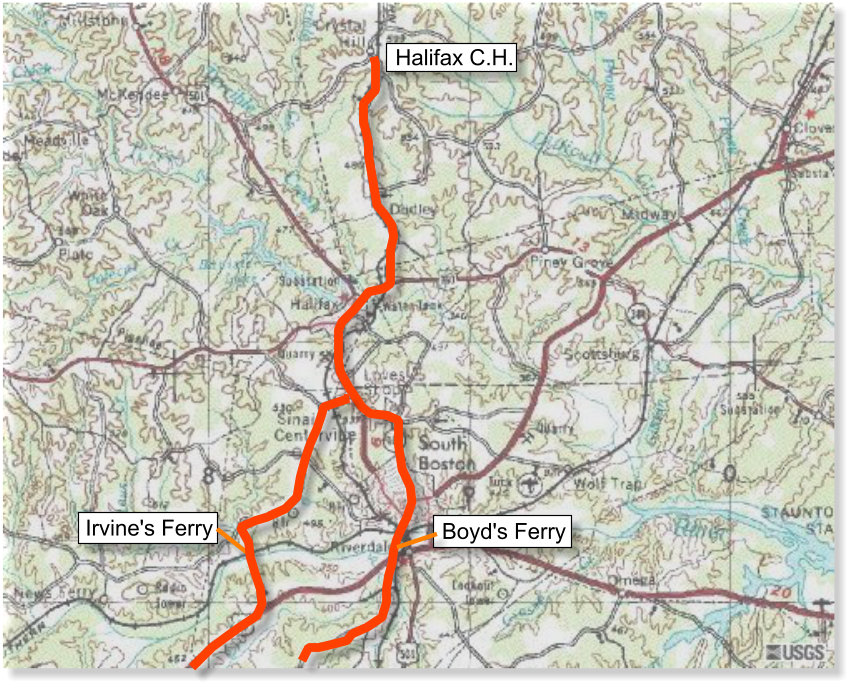
The spring campaign of 1781 was one of operations, and there was no retreat of General Greene which did not constitute a maneuver, having in view an ultimate engagement, with the recovery of the South as the chief objective. According to Lee, "No operation during the war more attracted the public attention than this did." If Greene's army were to be destroyed, the South would have inevitably become members of the British Empire. Carrington recalled in 1809 that "when the retreat was determined on, it was predicated on the certain knowledge, that there was but one boat at Dixon's [Dix's] ferry, from which place, Cornwallis well prepared for rapid movement, was not much more distant than Greene, and that between there and Boyd's ferry inclusive, five more were to be found.... There were then no other boats in the river, other than the wide and shallow flats at the ferries, which it was impossible to carry against the current." Boats were moved from Dix’s to Irwin’s Ferry on the 9th or 10th. Including Dix’s, Irwin’s and Boyd’s, there were very few boats to be had on the Dan, hence it was relatively easy for Greene to have secured them. Johnson comments: "The boats were not actually collected at the point of transportation, for that also would have unmasked the General's designs; but they were secured at convenient distances, so as to admit of their being collected at a few hours warning." 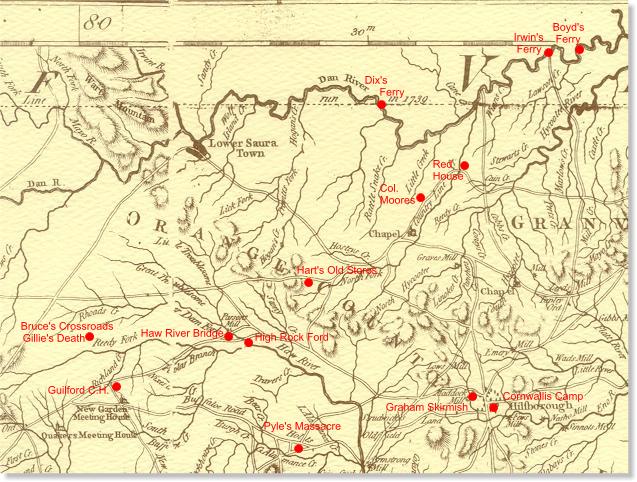
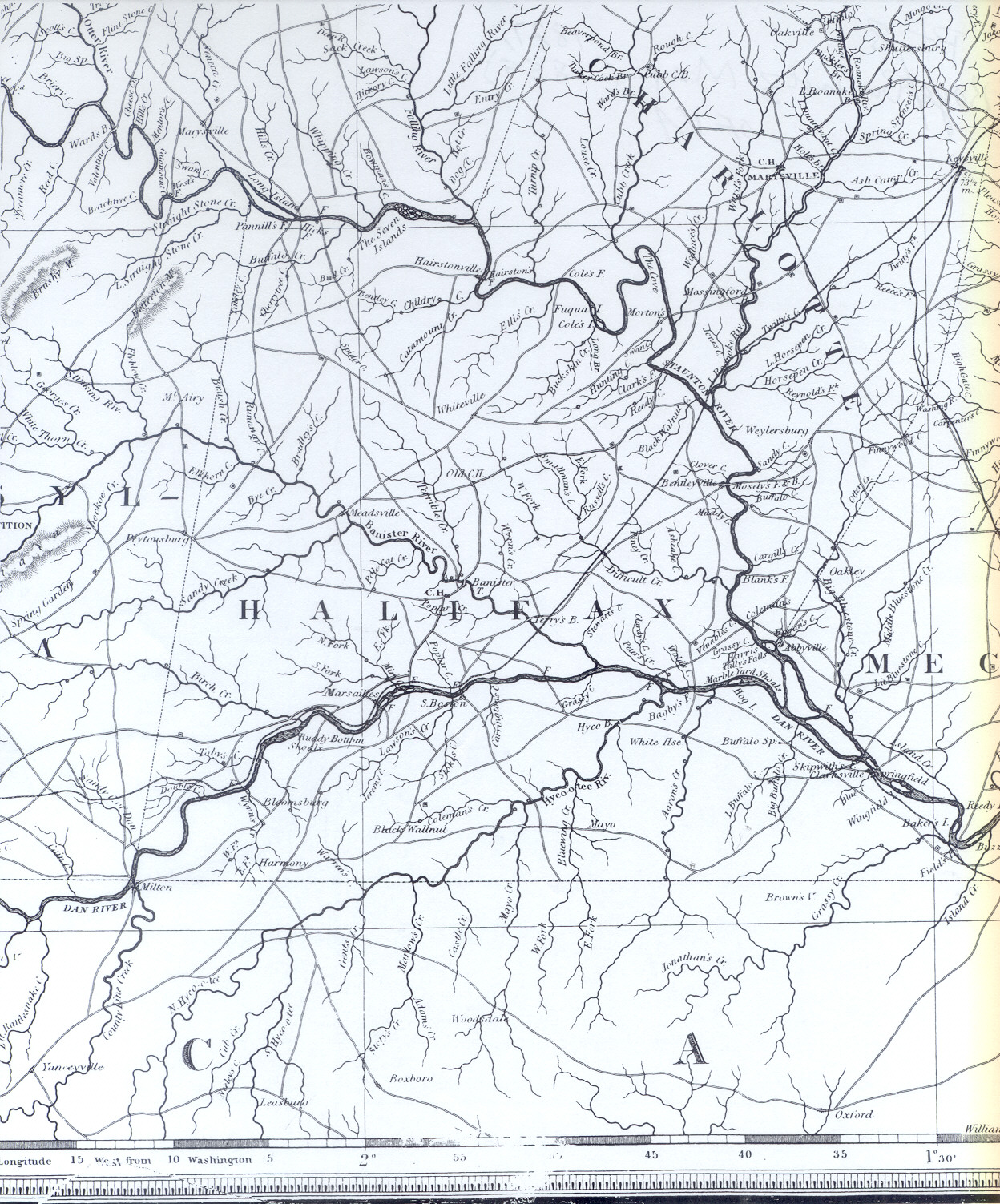
The Race Begins at Guilford C.H. and Ends with the Crossing of the Dan River Map portion from the 1775 Henry Mouzon - An Accurate Map of North and South Carolina --- Click on the map above at Irwin's or Boyd's Ferry to see plats of the actual locations. --- The race for the Dan was now on. The distance from Guilford was only seventy miles, but the season was still midwinter; it still rained and snowed intermittently. The roads, in a red-clay country, were frozen into a rough and broken surface at night, but by day softened into deep mud that clung to the wheels of the wagons, the hooves of the horses, and the feet of the men, so that yard after yard was gained only by an exhausting struggle. 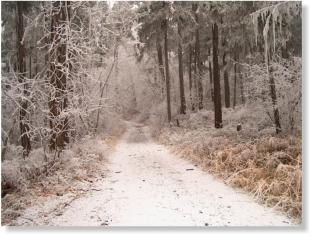
Letters written to Colonel John Gunby on February 11 th indicate that Greene had gotten near Haw Bridge, and High Rock Ford on the first day of the Race. The letter instructs Gunby to move the public stores from Hillsborough. "Such Stores as are for the immediate use of this Army you are desired to forward on by the shortest rout to a Colonel Moore's in Caswell County about thirty miles from Boyds Ferry; to proceed on from there to the ferry, & so on, untill they join the Army." The American Revolution of Pittsylvania County by Frances Hurt gives the obituary of Daniel Coleman, a Revolutionary War boy express rider, who died in 1860: "Coleman was employed as an express rider by military Commandant Nathaniel Terry of Halifax Old Town [Peytonsburg] to convey orders forward to him by Lafayette [from Richmond] ordering troops to rendezvous near Irvine's Ferry for the purpose of aiding General Greene then actively retreating before the advancing soldiers of Cornwallis. He delivered the order, the troops marched promptly ..." In a letter written to General John Butler the date and place show that Greene had gotten to Col. Moore's by the 13th. Williams and Cornwallis were on parallel roads, not far apart. At one time, when the British army had stretched out to the dangerous length of four miles, Cornwallis halted his van to bring up his rear and then pushed on with all possible speed, moving at times thirty miles a day, an almost inconceivable speed under the existing conditions. Williams had to travel as fast to keep ahead of the British. To guard against Cornwallis's making a detour and getting between the light troops and Greene's army, as well as to protect his own force from surprise, Williams had to send out such numerous patrols and establish such strong pickets that half of his force was always on night duty. He halted for only six hours each night; each man got only six hours rest in every forty-eight. They never set up a tent. "The heat of the fires was the only protection from rain and sometimes snow." They started each day at three in the morning and hastened forward to gain a distance ahead of their pursuers that would give them time for breakfast - breakfast, dinner, and supper in one, because this was their only meal for the day. Cornwallis came on with equal speed.
Lee's Legion formed the rear guard of the light troops. Williams sent Lee back along the road to verify this information. Lee, in turn, sent out Capt. Armstrong of the Legion cavalry, to reconnoiter. When Armstrong returned he apprised Lee of the British position, who moved to prepare an ambush. Capt. Armstrong with a small number of cavalry were sent in the path of Tarleton’s horsemen. Some British Legion cavalry, under a “Capt. Miller,” then galloped in pursuit only to be charged in the flank by Lee and his dragoons, who had lain concealed along the road. It was in this encounter that Lee’s bugler Gillies, a lad of fourteen years, who was made to take a poor mount in order that the local guide could be better horsed, was savagely killed by some British Legion dragoons. Lee: “This ill-fated boy was one of the band of music, and exclusively devoted in the field to his bugle, used in conveying orders. Too small to wield a sword, he was armed only with one pistol, as was the custom of the Legion; that sort of weapon being considered of little import in action; now he had not even his pistol, it being with the countryman mounted on his horse.” In reprisal he declared his intention of hanging one of his prisoners, Captain Miller, and was deterred only by the near approach of the British van, which compelled him to hasten to rejoin Williams. Lee’s dragoons, in view of the sight, swiftly retaliated. Though Tarleton speaks of Lee being finally repulsed, it would seem, tactically speaking, the Americans got the better of this action. According to Lee, British lost 18, Americans 1, with Miller being made prisoner. But Williams had decided that by now the British had been sufficiently misled as to the route taken by the main American army, and that Greene and Huger had had time to reach the Dan. Therefore, while Lee was engaging Tarleton's troop, he had taken a right-hand road leading to Irwin's Ferry, where he expected to find the main army. Lee's men, having missed their one meal of the day, took a byroad that would lead them to Williams and meanwhile give time to refresh themselves at a farmhouse. The byway was somewhat obscure, and Lee felt safe from immediate pursuit; but while the men and his horses were in the midst of their meal they heard shots in their rear. Cornwallis had discovered the short cut, and Lee's vedettes were signaling the near approach of the enemy's van.
Cornwallis still hoped to catch them before they crossed the Dan. He followed fast. More than once O'Hara in the van was within musket shot of Lee's rear guard. More than once it seemed that the light troops must stand and fight. When they came to a creek or a ravine, the British cavalry would rush forward to attack them in the confusion of crossing, but they always got across in time. At last Lee caught up with Williams. It was growing dark, and the Americans hoped that the enemy would halt for the night; but Cornwallis still came on, determined to run them down. Night fell and they could not see the rough and rutted road they traveled; it was hard going for the weary men.
But Williams had had a dispatch from Greene: "It is very evident that the enemy intend to push us over the river. . . . I sent off the baggage and stores with orders to cross as fast as they got to the river. The North Carolina militia have all deserted us, except about 80 men. . . . You have the flower of the army, don't expose the men too much, lest our situation grow more critical." The date of the dispatch, February 13, and the place from which it was sent made him sure that Greene would, by this time, be farther on the way. He reassured his men and led them on to find that the fires were burning where Greene had camped two days before. Friendly hands had kept them alight for the benefit of the light troops. But they could not stop to enjoy them. They kept on until news arrived from the rear that the British had halted. Then they paused for two or three hours, still a long distance from the river. At midnight they were again afoot. In the morning came another dispatch from Greene, sent the same day as the last: "4 o'clock. Follow our route. I have not slept four hours since you left me, so great has been my solicitude to prepare for the worst."
At 2 in the afternoon, Greene writes another note to Colonel Otho Williams, "The greater part of our waggons are over, and the troops are crossing." They halted for an hour's rest and a hasty meal, started again, slogged through the mud, the enemy at their heels, and were still doggedly pushing on at noon when a courier met them, found Williams, gave him a note dated the night before: "Irwin's ferry, 12 past 5 o'clock. All our troops are over and the stage is clear. The infantry will cross here, the horse below. Major Hardman has posted his party in readiness on this (the south) side, and the infantry and artillery are posted on the other, and I am ready to receive you and give you a hearty welcome." Greene had the pleasure of seeing all the light army safe over that night, though in the day they had been pushed fourty miles by Cornwallis' army, whose van arrived just as the American's rear had crossed. Williams gave out the news. The word ran back through the column, and cheer after cheer followed it. They shouted so loud that O'Hara's van heard them and knew that the game was up. The reaction among the men was instantaneous. Their hearts were lifted, their strength renewed. For three hours more they hurried forward. They were now within fourteen miles of the river. Williams again detached Lee's cavalry to delay the enemy, while he took the rest of his command on to Irwin's Ferry. They got there before sunset, found the boats, and were ferried across. They had marched forty of the hardest miles that ever man traveled in about sixteen hours. 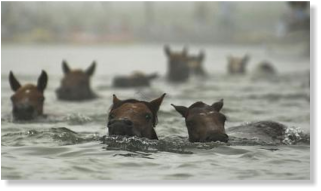 At dark, Lee's horsemen started after the others. Between eight and nine o'clock they got to Boyd's Ferry, just as the boats returned from transporting Williams's troops. The men took to the boats; the horses swam. "The horses were turned into the stream while the dragoons embarked in bateaux. The men were loaded in boats, but the luckless horses were turned into the flood to swim for it. Some in panic swam back to the Carolina shore and made for the woods. By midnight they were all across. They had hardly landed when the British van arrived at the river."
Cornwallis got the news in the course of the evening. The river was too high to cross without boats, and every boat was on the farther shore. Greene had won the race. On the 14th, Greene had crossed the Dan River at Irwin’s Ferry, thanks to the prior collection of boats by Lieut. Col. Edward Carrington, and a survey of the river made by Capt. John Smith of the Maryland line.  Lieut. Col. Carrington, who had been personally superintending the crossings, and Lieut. Col. Lee, were among the very last to make the passage.
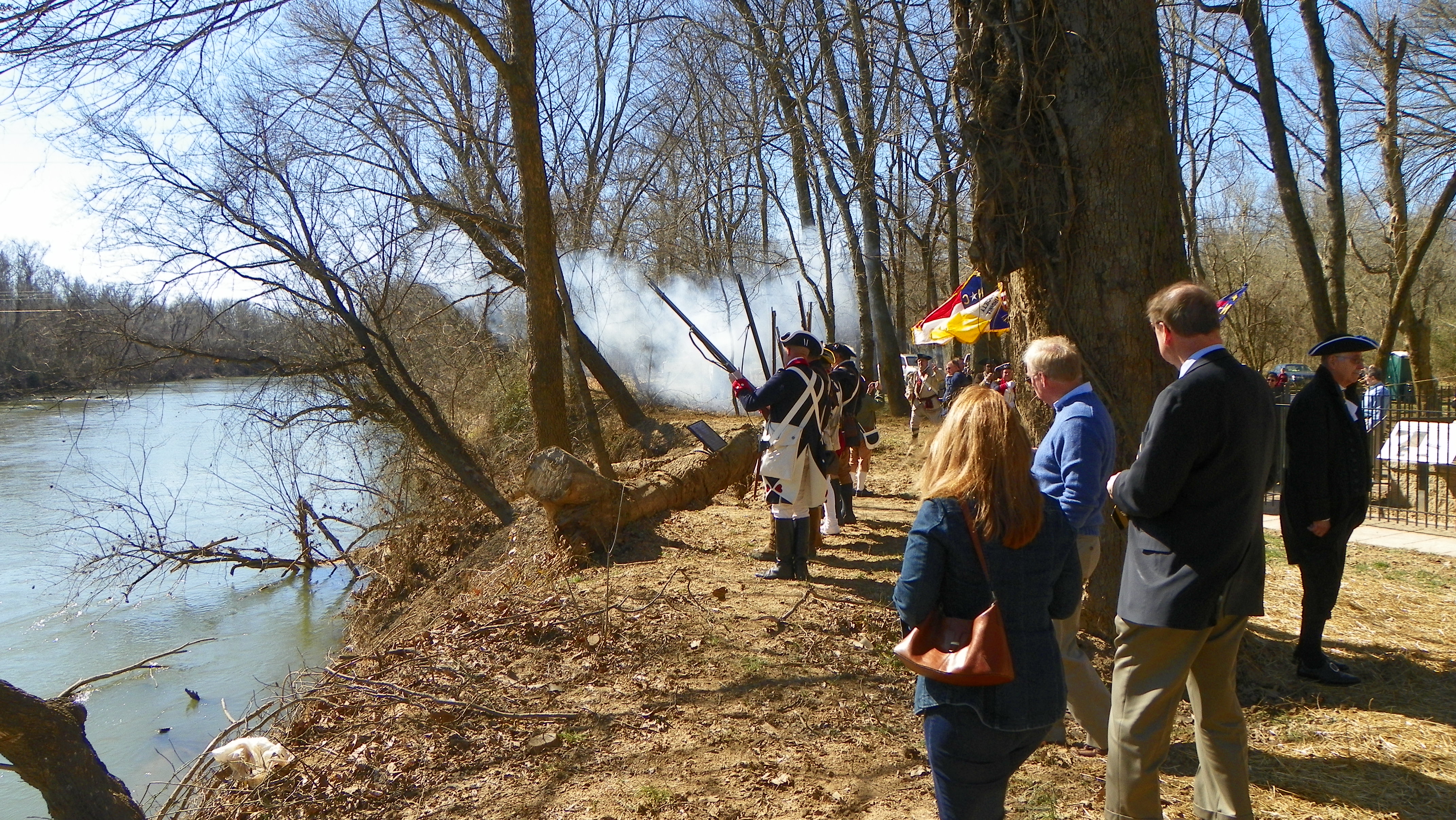
When the van of Cornwallis’ army reached Irwin’s, six hours after the last group of Americans had made it across, Greene’s men cheered -- which the soldiers of O’Hara’s advance column were close enough to have heard. In an effort to more fully visualize the Crossing of the Dan, a few calculations are helpful in understanding what the scene may have looked like. Greene's total force was reportedly 2036 men during the Council of War at Guilford. Carrington had been quoted earlier as saying there were only 6 boats available between Dix's and Boyd's Ferries. If we can use an estimate of 10 men per boat, there would have needed to be 204 boat crossings just for the troops. Each boat would have had to make 34 round trips to get the entire army across the Dan River. Assuming Greene's troops and wagons began the crossing near noon on the 14th, and that Lee's troops finished around 9 p.m., the entire crossing took 9 hours. Is it reasonable to think that each boat could make 34 trips in a 9 hour period? This would be about 15 minutes per round trip. What does this mean? There must have been more boats. From pension records we know there were several smaller boats and canoes involved in the process from Pittsylvania County. It is likely that boats were scattered along the river bank from Irvin's Ferry all way to Boyd’s Ferry 3 - 4 miles downriver in order to speed the crossing of the whole army. Because the crossing was not completed until 9 p.m. reception parties are likely to have maintained fires on both sides of the river banks to indicate crossing points and to provide light. (See February 2011 photo at Boyd's Ferry ) The British proceeded without intermission to Boyd's Ferry, where they found some works evacuated, which had been constructed to cover the retreat of the enemy, who six hours before had finished their passage, and were then encamped on the opposite bank. In a letter to Lord Germaine, of March nineteenth, Cornwallis says, "I was informed that the American commander could not collect many flats at any of the ferries on the River Dan." Colonel Carrington, however, had been specially charged with this duty by General Greene, with the aid of Captain Smith, of the Maryland line; had anticipated almost any contingency which should require the passage of the river; and so provided boats at Boyd's and Irwin's ferries, which were neighboring ferries, that on the fourteenth of February the whole division safely crossed the river, secured their boats, and were beyond reach of the enemy. Tarleton thus reports this affair: "The light army (Williams) which was the last in crossing, was so closely pursued, that scarcely had its rear landed when the British advance appeared on the opposite bank; and in the last twenty-four hours it is said to have marched forty miles. The hardships suffered by the British troops for want of their tents and usual baggage, in this long and rapid pursuit through a wild and unsettled country, were uncommonly great; yet such was their ardor in the service that they submitted to them, without a blow, to the American army, before it crossed the Roanoke." Tarleton adds, "That the American army escaped without suffering any material injury, seems more owing to a train of fortunate incidents, judiciously improved by their commander, than to any want of enterprise or activity in the army that pursued. Yet the operations of Lord Cornwallis, during the pursuit, would probably have been more efficacious, had not the unfortunate affair at the Cowpens deprived him of almost the whole of his light troops."
"Much credit is due to Lieutenant-Colonel Carrington on this occasion. The enemy are on the other side of the river, and, as it is falling, I expect it will be fordable before night; and the fords are so numerous, and the enemy lie in such an advantageous situation for crossing, that it would be a folly to think of defending them, as it would reduce our force to small parties; which might prove our ruin." "The miserable situation of the troops, for want of clothing, has rendered the march the most painful imaginable, several hundreds of the soldiers tracking the ground with their bloody feet." Greene's strategy in plan and in execution had been masterful. He had saved his army and rejoiced the hearts of the patriots throughout America. So much he had done, and it was not little. But after all it was a retreat; though armies may be saved, campaigns are not often won by retreating. Behind him lay the south, still completely dominated by the enemy. He had dragged Cornwallis away from his base and worn down his army. While some of Greene's troops stayed on the north bank of the Dan for surveillance, the main army moved north crossing the Banister River at Cowford, near this site, on to the old Halifax Court House at Crystal Hill some five or six miles north of the Banister on Rt. 626. 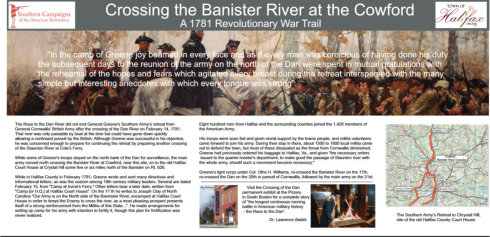 While in Halifax County in February 1781, Greene wrote and sent many directives and informational letters, as was the custom among 18th century military leaders. Several are dated February 15, from "Camp at Irvine's Ferry." Other letters bear a later date, written from "Camp [or H.Q.] at Hallifax Court House". On the 17 th he writes to Joseph Clay of North Carolina "Our Army is on the North side of the Bannister River, encamped at Halifax Court House in order to tempt the Enemy to cross the river, as a most pleasing prospect presents itself of a strong reinforcement from the Militia of this State...". He made arrangements for setting up camp for his army with intention to fortify it, though this plan for fortification was never realized. The location of the court house at that time was in fact some five or six miles north of the Banister, near what is now Crystal Hill, west of Rt. 626. (See the 1909 plat showing the exact location of the courthouse.) Eight hundred men from Halifax and surrounding counties joined the 1,428 members of the American Army. His troops were soon fed and given moral support by the towns people, and militia volunteers came forward to join his army. During their stay in there, about 1500 to 1800 local militia came out to defend the town, but most of these dissipated as the threat from Cornwallis diminished. Greene had previously ordered his baggage to Halifax, Va., and given "the necessary orders issued to the quarter-master's department, to make good the passage of Staunton river with the whole army, should such a movement become necessary." Johnson: “Sending off, and guarding the many detachments of baggage, stores, prisoners, sick, &c., had necessarily drawn off a number of men on detached commands. The militia alone could not be depended upon for this service, as they came and went when they pleased. Hence a small guard of regulars became indispensable; and where an auxiliary militia force was called out, it was relieved at different stages, according to the necessity of circumstances. On the 17th of this month, there was no less than 345 of Maryland line thus employed; and, on that day, every man in camp fit for duty, is stated at, infantry, 1078 -- artillery, 64 –- cavalry, 176 --- legionary infantry, 112. The militia had all departed, with the exception only of the gallant little band under Pickens, who alone, in the worst of times, never abandoned the retreating army: but, at this time, they were detached under their leader, on the service which has been already noticed" "The Army being in great distress for want of a number of bags, to transport the Meal for the Troops, Casks being found very inconvenient, [...] The Inhabitants of Hallifax County are therefore desir'd to furnish for the use of the public [i.e., the army] immediately, three hundred to be brought to the Army as soon as possible. The Army cannot get a supply in any other way..." [Nath. Greene Papers, Feb. 16, 1781] It is not known how the inhabitants of the county responded to this call for cloth bags to hold milled grain, but presumably they brought in enough bags, as no further request was needed. 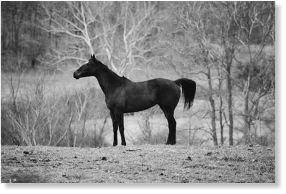 "The importance of having all the Dragons [cavalry men] mounted who are actually in the field to enable us to oppose the enemy with success and prevent their ravaging the country and collecting horses induces me to authorise and require you immediately to impress a sufficient number of good Dragoon horses to mount all the men in your detachment who are dismounted. In the execution of this warrant, the Officers must be instructed to treat the Inhabitants with tenderness, to inform them of the expediency of this measure, to have the horses valued and give proper certificates for them."
"You will make me a return of the horses impressed and the person from whom they were received with their valuation. They must be immediately branded and considered as public property." [Nath. Greene Papers, Feb. 16, 1781, addressed to Lt. Col [William] Washington] Again, there is no known record of the horses thus impressed into service, with provision for paying their owners after the war by redeeming their certificates. However, the general had to take further action, as revealed in the following directive: "I am this moment informed that a number of the first covering horses [i.e., the best stallions] have been impressed for the Dragon service such as will be valued at 800 or 1000 hard dollars. This is not contrary to my intention as well as the public interest, that you are desired to give particular orders to your officers not to have those high[ly] prized covering horses taken. Indeed the Stallions should not be taken at any rate; for they will not answer for immediate services..." [Nath. Greene Papers, Feb. 17, 1781] Greene was clearly upset by the prospect of so many of the county inhabitants having their prized stallions taken from them, and also by the thought that they would have to be paid dearly for them when the war ended. He repeated his instructions that proper records be made, including the owner's name and the horse's value: "The officers must have particular directions to give proper Certificates. Otherwise the people will think they are plunder'd." [Same source] [On British prisoners, captured at the Cowpens on Jan. 17, 1781] Having completed his mission of bringing militia home and delivering Cowpens prisoners to Pittsylvania Court House, Brig. Gen. Edward Stevens received orders on February 19 to recruit Virginia militia. By the 21st to 23rd he had joined Greene, coming by way of Halifax, Virginia, having raised 1,000 men. Writing to Nath. Hunt, Esqr, Sheriff of the County of Halifax on February 20, Greene says "The prisoners of war delivered [to] you agreeable to the enclosed List you will send to Charlotville [six] under a proper guard. You will take especial care that none of them make their escape and take the receipt of the Commissary of Prisoners for them. You will take care that they are furnished with provisions agreeable to the resolutions of Congress and proper certificates given for the same." On the 15th, Cornwallis camped at Wiley’s House and rested his hard pushed troops. The Dan River began to fall, thus making possible crossing and pursuit by Cornwallis more easy. Cornwallis, however, continued on to Hillsborough. With a mind to raising and emboldening the loyalists. Pickens, with 700 men, at least half mounted, kept to the west of him, watching and harrying his flanks. Greene’s light corps under Williams, crossed the Banister River on the 17th and then re-crossed the Dan on the 20th in pursuit of Cornwallis, followed by the main army on the 21st. Two sub-detachments under Lee and Washington acted semi-independently of Williams (Lee’s in particular.) In the ensuing days, Lee would be joined by reinforcements of Virginia riflemen, North Carolina militia, and a number of Catawba Indians. The light detachments were to follow on the rear of Cornwallis’ column and retard his movements. By the 21st, Lee had joined his troops with those of Pickens for purposes of their acting together. Major Pierce, one of Green's aids, with a small but select escort, equipped equally to fight or fly, was already in advance of them and hung on Cornwallis wings after the latter had retreated from the Dan.
Irvine stated he received subsequent orders from General Greene by a messenger to deliver the supplies to a receiving officer at Prince Edward Court House, which Irvine accordingly did. He returned home to find that the British not only had reached Irvine's Ferry that he and his brothers operated but also had destroyed their farm and crops, burned their fences, and killed their stock before returning to North Carolina. Irvine stated that he made ready to join General Greene when Quartermaster William McCraw came and dispatched him to collect wagons and convey provisions to Greene. Four wagons with teams were employed,loaded with meal, and overtook General Greene's army at the Reedy Fork of the Haw River in North Carolina. Irvine returned to Halifax County for more provisions." On February 21 Greene rode alone with some aides to meet with Pickens and Lee at Pickens' camp, to plan operations. Greene gave instructions for them to prevent the loyalists from collecting, while assigning Pickens, at least formally, to command Lee's. He spent the night at Pickens’ camp, and then returned to his headquarters army at Halifax the next morning (the 22nd.) Greene, says Joseph Graham, ordered his various light detachments: “to proceed with caution and commit nothing to hazard against a superior force, unless compelled; but if meeting an inferior force, to strike them as quick as possible return to him as soon as an alarm should be given, it might be expected that the Cavalry and light troops of the enemy would be at our heels.” By the twenty-third the whole British army was demonstrating towards Guilford, and Lee and Pickens hovered near the outposts of Cornwallis. At this time the loyalists were organizing a corps under Colonel Pyle upon the marshes of the Haw, and Tarleton was sent to assist and protect them. More than four hundred had collected a little north of the old Hillsborough and Salisbury road, two miles from the Allamance River. Lee and Pickens fell in with this party, having been advised of their movements by two men whom they picked up while hunting for Tarleton. Tarleton says, "the loyalists were proceeding to Tarleton's encampment, unapprehensive of danger, when they were met in a lane, by Lee with his legion. Unfortunately, mistaking the American cavalry for Tarleton's dragoons they allowed themselves to be surrounded; no quarter was granted; between two and three hundred were inhumanly butchered. Humanity shudders at the recital, but cold and unfeeling policy aroused it, as the most effective means of intimidating the friends of royal government." After only a week's encampment, Greene had sufficient promises and reports of help on the way to recross the river. Greene and the main army re-crossed the Dan River into North Carolina on the 22nd. Greene then pursued Cornwallis and gave battle on March 15, 1781, at Guilford Court House in North Carolina, on ground he had himself chosen. Although this battle was a tactical success for the British, the Americans nevertheless gained a decisive strategic advantage, for the enemy, being too much shattered to continue the contest, Cornwallis retired to Wilmington, from which point he moved into Virginia to effect a junction with the forces of General Phillips. Greene immediately turned his face southward, leaving Cornwallis to proceed unmolested into Virginia. Greene's reasons for this move were given to Washington in a letter on 29 March, as follows : "I am determined to carry the war immediately into South Carolina. The enemy will be obliged to follow us, or give up the posts in that state."
In only twenty months, Greene succeeded in capturing all of the British posts taking 3,500 prisoners and splitting the British Army in half, bottling them up in Charleston and Wilmington. He also played a vital role in the re-establishment of civil government in the South. (If you have the time, read this great letter from Earl Cornwallis to Lord George Germain, dated Guildford, March 17th, 1781. It describes all the events from Cowpens to the Battle of Guilford C.H. ) After the Guilford Courthouse battle, British commander Lord Charles Cornwallis was forced to withdraw to the coast for supplies and reinforcements. Cornwallis realized American General Nathanael Greene's partisan war of attrition was taking a toll in British lives. He determined the best way to destroy Greene's army and subdue the south was to destroy the breadbasket state - Virginia - which provided short term militia reinforcements and met patriot supply needs with salt, flour, ammunition and tobacco for foreign credit. "After the big battle in central Guilford County, Lord Cornwallis moved almost due south, . . "See "Lord Charles Cornwallis's March Down the Cape Fear River". Cornwallis wrote General Phillips, in part: "The fate of it was long doubtful. We had not a regiment or corps that did not at some time give way." In short, four days after the sanguinary contest, leaving many of his own wounded and all of the Americans under a flag, he began his retrograde march; while, seven months from that day, a war lasting that number of years practically ceased, and the liberty of the people of the United States of North America was conclusively wrought out, "in the trenches before Yorktown, in Virginia."
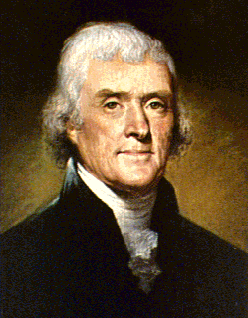
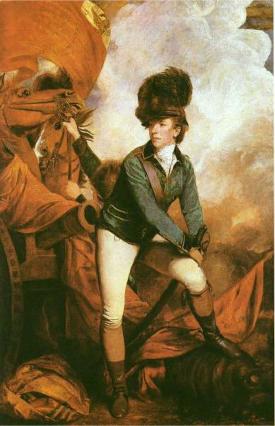
Cornwallis marched to Petersburg with 1,500 troops where he joined other British forces that had been raiding along the James River. From May to July Cornwallis maneuvered with the main American force under Lafayette in an effort to trap and defeat it. Cornwallis was soon ordered by Sir Henry Clinton, overall British commander in North America, to concentrate British forces on the coast, send reinforcements to New York and establish a base of operations around Gloucester and Yorktown. Clinton was afraid Washington was going to attempt to capture New York and wanted to fend off that threat while Cornwallis established a base in Virginia. Governor Thomas Jefferson and the Legislature had to flee from the capital in Williamsburg to Richmond, and later still to Charlottesville. When the army reached the James River, Cornwallis then sent one detachment, under General Simcoe, to keep General Greene from receiving arms and stores, and dispatched another detachment, under Colonel Tarleton, on a raid right across the state of Virginia, to capture Governor Jefferson and the Legislature. Tarleton was delighted with his mission having 180 trusted dragoons and 70 mounted infantry on fine horses. He was partially successful. Being warned of the approaching troops, Governor Jefferson avoided capture by only ten minutes, while seven of members of the Legislature were captured.
The Loyalist districts in the Carolinas in most cases were cut off from the coast by districts populated with ardent rebels, while behind them lay a mountain region full of wild frontiersmen, bred to warfare from birth, well armed and frequently well mounted, and possessed of a hatred for the down-country planters that went back to old grievances and jealousies having nothing to do with the British allegiance. Add to this the fact that the militia organisation in the southern provinces had been in the hands of the rebels from the first, and you will see why the Carolina loyalists were doomed. The state of affairs in North Carolina is best summed up in a letter written from the American general Greene's headquarters at Deep River, not far from the scene of a hideous massacre of Scots loyalists at Altamahaw Ford on their way to join Tarleton's Legion. Dated March 30, 1781, it says in part, "Nothing but blood and slaughter has prevailed amongst the Whigs and Tories, and their inveteracy against each other must if it continues depopulate this part of the country." In the late summer of 1781 when George Washington and Rochambeau heard of Lord Cornwallis' encampment in Yorktown they raced southward from New York to link up with the French fleet under Admiral Comte de Grasse in Chesapeake Bay. Washington arrived just in time to bottle-up the British, who were anticipating reinforcements that never came from either General Henry Clinton or the British fleet. 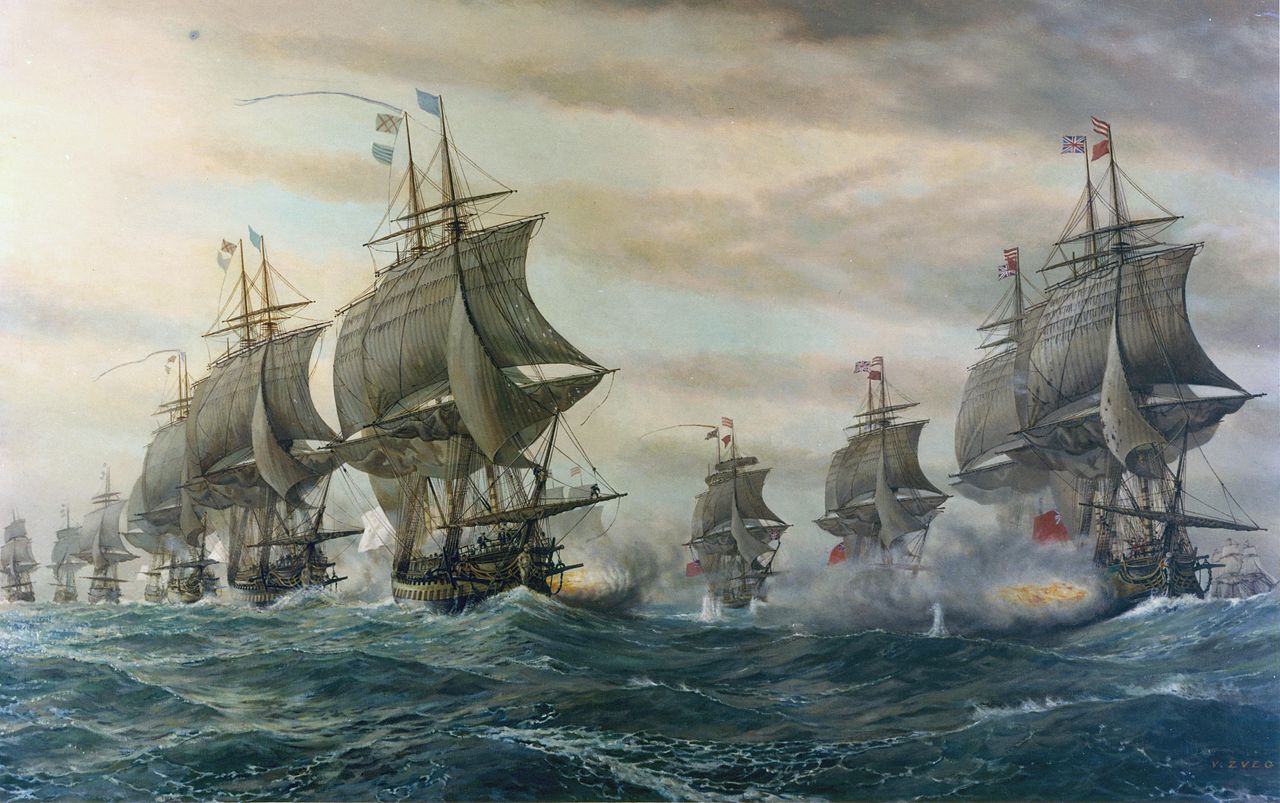 Off shore, the French fleet effectively blocked aid from Cornwallis while Washington made life unbearable for the British troops with three weeks of shelling. Thomas Nelson a signer of the Declaration of Independence was also engaged in the final siege of Yorktown. Nelson being a true patriot, urged General Washington to fire on his own home, the Nelson House, where Cornwallis had his headquarters.
Lord Cornwallis' finally surrendered on October 19, 1781 and this ended the disastrous British southern campaign. The loyalist and Patriot forces in the south had fought a series of savage fights that left both sides bloodied. These engagements sent Cornwallis limping into Yorktown in late summer trailed by a force led by the Marquis de Lafayette a French Ally. Cornwallis attempted to surrender over 8,000 men to the French through his second-in-command, Charles O'Hara. French General Comte de Rochambeau, however, directed O'Hara to George Washington, who steered the British officer to his own second in command, Major General Benjamin Lincoln.
Approaching the Allied Commanders, O'Hara offered Cornwallis' sword to Count Rochambeau, leader of the French forces. Rochambeau refused, directing him to Gen. Washington who in turn directed him to General Benjamin Lincoln who accepted the sword. Two things here: first, military protocol dictated that neither Rochambeau nor Washington should accept the sword from someone who was beneath their position. Second, the supreme irony of Gen. Lincoln's acceptance of Cornwallis' sword was not lost on the British in that Lincoln had been humiliated by the British forces at the Battle of Charleston a year earlier. As the surrender ceremony began, the scarlet-coated British and their Hessian allies in blue and green moved forward, followed by the German mercenaries. As they marched into the field throwing down their arms--- amid the weeping and cursing of defeated soldiers--- the Redcoat bands played "The World Turned Upside Down." As the Marquis de Lafayette wrote, "The play is over, the fifth act has come to an end." Only 7,700 surrendered at Yorktown. There were still 13,000 British soldiers in New York "and another 13,000 regulars and armed loyalists scattered from Canada to Savannah, Georgia." (The Perils of Peace, America's Struggle for Survival After Yorktown by Thomas Fleming.) In the summer of 1782, nearly 2 years after first taking command of the Southern Army, Greene was outside Charleston with a force too small to attack the remaining British inside the city. The same was true for General "Mad" Anthony Wayne, with only 523 men posted outside Savannah. The Southern Campaign was ending as it had begun. Their letters echoed the ones written 19 months earlier: "There never was an army more distressed or more discontented". Officers and men were in rags. Every ounce of food received was gotten by "either at the price of blood or the hazard of life" Finally, on Dec. 13, 1782, word came that the British would sail next day from Charleston, their last stronghold in the South. However, the South Carolina governor, Guerard, was eager to see Greene's army leave quickly and angered him to the point where Greene had to threatened military action. Raymond Starr, has written of the incident, "It is frightening to think what might have developed had there continued to be a reason to maintain a Continental army in the state." "On March 10 of 1783 a litany of mounting grievances by Continental army officers reached a crescendo. Complaints were many: arrears in pay, failure to settle food and clothing accounts and Congress' lack of action in making provisions for the life pension of half pay." This led to The Newburgh Address where the remnants of the army in New York threatened to leave Congress without an army if the war continued. "The Congress itself in June of 1783 was scared out of Philadelphia by a few hundred newly released soldiers and some civilians who threatened to rob the national bank and hold the delegates hostage. Although nothing beyond the exchange of some acrimonious threats and insults occurred, Congress deserted Philadelphia for Princeton, not to return to the City of Brotherly Love until after the national Constitution had been adopted." (The Rise and Fall of the Newburgh Conspiracy - How General Washington and his Spectacles Saved the Republic by George L. Marshall, Jr.) "It wasn't until November 25, 1783, that the last British soldiers withdrew from New York City, nearly three months after the Treaty of Paris had been signed. William Gilmore, in his The Life of Nathanael Greene writes: "Without a blow being struck, Greene had gained a most important victory; and the reputation of the British general, and the cause in which he was engaged, was destined to suffer proportionally. The remarkable chase and escape which we have just recorded, was one of the most impressive of the incidents of the war. It had riveted the attention of both friends and foes, from the moment of its beginning, on the southern side of the Catawba, to the time when it ended by throwing the swollen waters of the Dan between the opposing armies." Greene's strategy in plan and in execution had been masterly. He had saved his army and rejoiced the hearts of the patriots throughout America."Every measure of the Americans during the march from Catawba to Virginia was judiciously designed and vigorously executed." General Francis Vinton Greene estimates the importance and results of Greene's southern campaign in the following words: "The retreat to the Dan and the battle of Guilford were to the South what the retreat across New Jersey and the battles of Trenton and Princeton were to the North. They turned the tide; and each attracted equal attention in Europe. Greene lost the battle, but he won the campaign, and the first step towards Yorktown was taken." The event was so popular that it led to a song written to the tune of "Yankee Doodle" The like was never seen sir, Much retrograde and much advance And all with General Greene, sir. They rambled up and rambled down, Joined hands and off they ran, sir, And General Greene was like to drown Cornwallis in the Dan, sir. |
 Back to Page One Also see The Retreat To The Dan Memorial and Links to Resources.
| This story of "The Crossing of the Dan" has been assembled from many sources. This author takes no credit whatsoever for any of the content. I am in the process of seeking permission from the many sources used. Please email your questions and comments. Last update: January 9, 2020 |