& the Early Explorers

"The Storyteller"
Painting by Martin Pate, Newnan, GA Courtesy Southeast Archeological Center, National Park Service
www.pateart.com http://www.nps.gov/history/seac/index.htm
The very first travelers to Halifax County, Virginia, may have come and gone without leaving any clue as to whom they may have been. All that we find are the shaped stones they left behind. Spearpoints, knives, and axes found in this area have been dated back from 8,000 to 10,000 years ago. Excavations at Cactus Hill, on the Nottoway River in southeastern Virginia, have uncovered points, blades, and other evidence that are 15,000 to 17,000 years old.
Scattered throughout the plains of western Canada and the United States are hundreds of prehistoric rock structures estimated to be over 10,000 years old and are known today as Medicine Wheels. Many have speculated as to what they were created for but more recent tribes have interpreted their purpose as being a teaching tool and and a place to connect to the spirit world and Creator.
 Three-step colonization model PLoS ONE. 2008 |
Others propose a three-stage colonization process for the peopling of the New World beginning 40,000 years ago. The first stage was a period of gradual population growth as ancestors diverged from the central Asian gene pool and moved north and east into Siberia. This was followed by an extended period of population stability in greater Beringia between 36,000 and 16,000 b.c. The final stage was a single, rapid population expansion of the New World from Beringia. (A Three-Stage Colonization Model for the Peopling of the Americas
Giants Were Here First
“These giants denied the existence of a Great Spirit, so he caused a great rain storm to come, and the water kept rising higher and higher so that it drove these proud, and conceited giants from the low ground to the hills, and thence to the mountains, but at last even the mountain tops were submerged and then those mammoth men were all drowned. After the flood had subsided, the Great Spirit came to the conclusion that he had made man too large and powerful, and that he would therefore, correct the mistake by creating a race of men of smaller size and less strength. This is the reason, say the Indians that modern men are small and not like the giants of old. They claim that this story is a matter of Indian history, which has been handed down among them from time immemorial.” Steve Quayle
Unbelieveable as this all sounds to be, there is other proof of giants, not just humans - see Giant Petrified Trees (and Other Giants) and here.
 "The arrival of the Englishemen in Virginia." Map of Ralegh's Virginia (present-day North Carolina) engraved by Theodor de Bry ("T. B."). Plate II from the illustrated English edition of Hariot’s A Briefe and True Report of the New Found Land of Virginia published by Theodor de Bry in 1590. |
The Early Contact Period (A.D. 1500-1750)
A network of trails in eastern North America were developed and used by Native Americans which ran through the Great Appalachian Valley . The system of footpaths extended from what is now upper New York state to deep within Georgia. Various Indians traded and made war along the trails traveling hundreds of miles at times. The Great Trading Path passed through Occoneeche Island in what is now Clarksville, VA.
Between the 16th and 19th centuries as indigenous Native Americans, colonizing Europeans, and Africans came into sustained contact in North America, their cultures underwent a variety of complex transformations.
War: Scholars estimate that over one thousand battles and wars between Native groups and peoples of European descent took place between 1500 and 1890.
Smallpox: "Prior to the arrival of Europeans, various sources estimate native population in North and South America at 90 - 100 million. In the 1500s, the American Indian population in North America has been estimated at approximately 12 million, but by the early 1900s, the population had been reduced to roughly 474,000. It is impossible to arrive at a number for the millions of American Indians killed during this period by European diseases - with smallpox the deadliest by far."
"Native populations of the Americas lacked immunity to the infectious diseases that had ravaged Europe and Asia for centuries. ... The "white man" diseases - measles, chicken pox, typhus, typhoid fever, dysentery, scarlet fever, diphtheria, and after 1832, cholera - were devastating to the American Indian. Lumped together, these diseases did not equal the havoc of smallpox in terms of number of deaths, realignment of tribal alliances, and subsequent changes in Canadian and American Indian Cultures." (From Plains Indian Smallpox, by O. Ned Eddins)
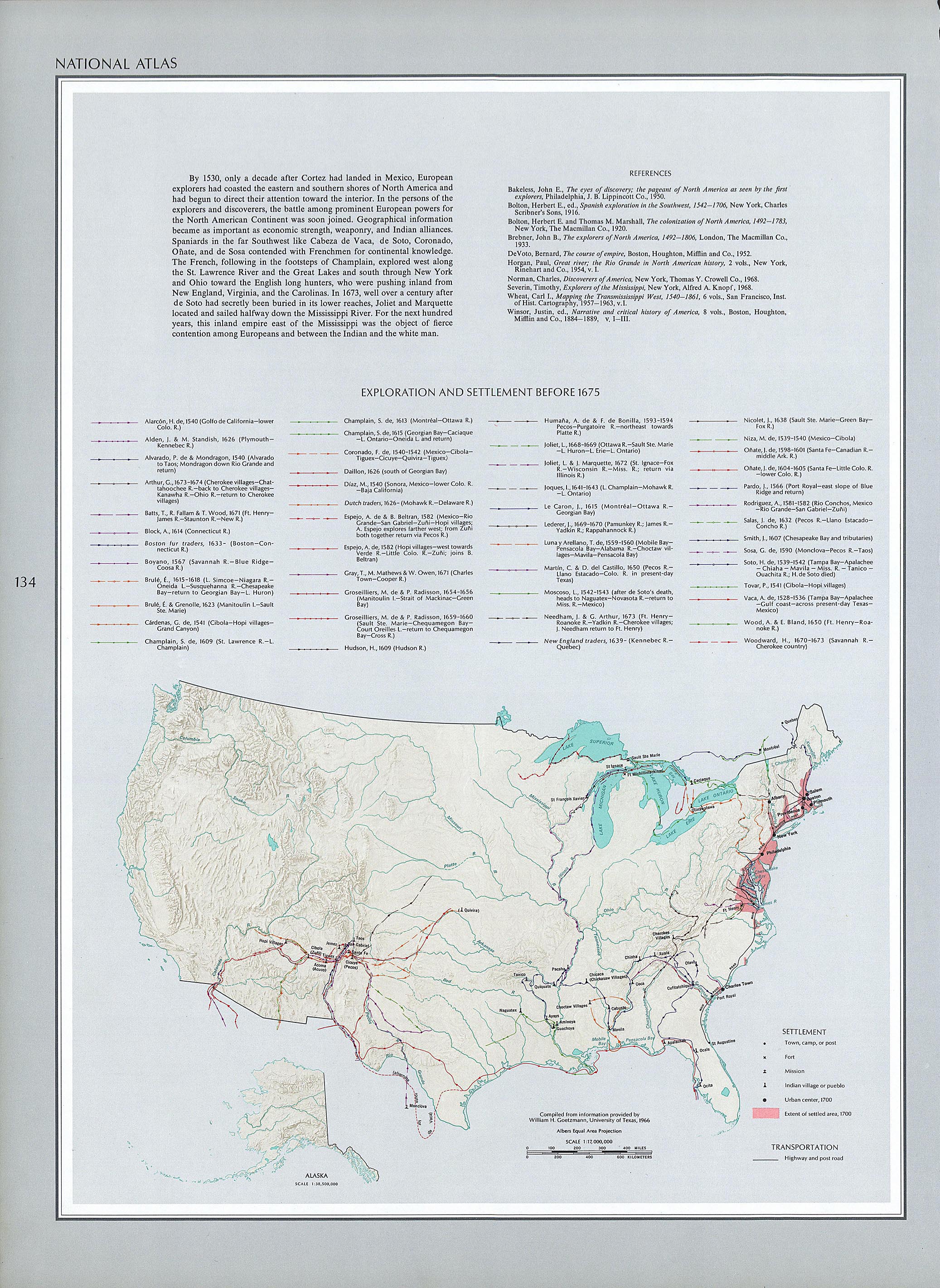 |
| US exploration and settlement before 1675 |
The native peoples that early European explorers found in the area called "the Upper Country," "the hilly Parts," "Hill-Country," or "the Highlands" were politically independent but culturally related. From Esaws along the Catawba River to Mannahoacs on the Rappahannock, all were descended from Siouan-speaking migrants who had drifted over the mountains centuries before Columbus. As they fanned out along the rivers slicing through the upcountry, some of their cultural uniformity dissolved. A "people" became one village or a cluster of settlements. Contact with different neighbors fostered diverse pottery styles and arrowhead shapes and may also have touched other, less visible, modes of existence. In the more southern villages a warmer climate and perhaps also her soils encouraged heavier reliance upon agriculture. And everywhere the passage of time encouraged the growth of a babel of languages from the Siouan root. Still, these societies were variations on a common theme. A fundamental unity underlay piedmont life, a unity grounded in a shared cultural heritage and physical environment. All spoke Siouan. All built towns on terraces above the rivers and creeks. All followed a seasonal routine that balanced farming the rich alluvial soils in the bottomlands, fishing the nearby waterways, hunting in the hills or canebrakes, and gathering wild plants at selected spots.
Some may even have retained a vague sense of kinship despite time and distance. While upcountry warriors launched raids on outsiders in every direction, conflict within the piedmont itself apparently was rare or nonexistent. Monacans are our "neighbours and friends," said the Mannahoac Amoroleck in 1608, "and did dwell as [we] in the hilly Countries by small rivers." Neighbors and friends leading similar lives in the hill country - this was the southern piedmont in the centuries before European contact.
After people arrived from across the sea, these Indians also shared a common destiny. They were far enough away from the coast to be spared the shock of having colonists land in their midst, but not far enough away to avoid men toting foreign bacterial and technological baggage. Weakened by the bacteria, attracted by the technology, perhaps sobered by the fate of coastal groups that fought European intrusions, upcountry Indians would choose cooperation and survival rather than resistance and ruin.
The "desire for quick profits was the most powerful motive of discovery in the new world. It was the hope of gain that lured men to undertake the long, wearisome, and dangerous voyage across the Atlantic and incited explorer, warrior, and trader to plunge into the interior through the unknown dangers of the almost impenetrable forests."
"The hope of profits moved the statesmen at home to urge these adventurers to renewed efforts and to play their own cards craftily in the diplomatic game. The great nations of Europe were all seeking to acquire dominion in America that they might share in the treasures of the "Indies." Spain had been first, then came Portugal; and after a hundred years, the two great rivals, France and England, reached out for North America. Their stake in the game of profits was the great interior valley, long before discovered by Spanish adventurers, but never exploited and so almost forgotten." (First Explorations of the Trans-Alleghany Region by the Virginians 1650- 1674, By Clarence Walworth Alvord and Lee Bidgood. Published by The Arthur H. Clark Company, Cleveland, Ohio, 1912)
 John Lederer:
The first European who explored west of the Blue Ridge was not English but a German, John Lederer. He went on three expeditions to the Blue Ridge between 1669-1670.
John Lederer:
The first European who explored west of the Blue Ridge was not English but a German, John Lederer. He went on three expeditions to the Blue Ridge between 1669-1670.
He writes:"But before I treat of their ancient Manners and Customs, it is necessary I should shew by what means the knowledge of them hath been conveyed from former ages to posterity. Three ways they supply their want of Letters: first by Counters, secondly by Emblemes or Hieroglyphicks, thirdly by Tradition delivered in long Tales from father to son, which being children they are made to learn by rote."
• An on-line version of his writings can be found here: The Discoveries of John Lederer from Virginia to the West of Carolina, and other parts of the Continent. , published in 1672.
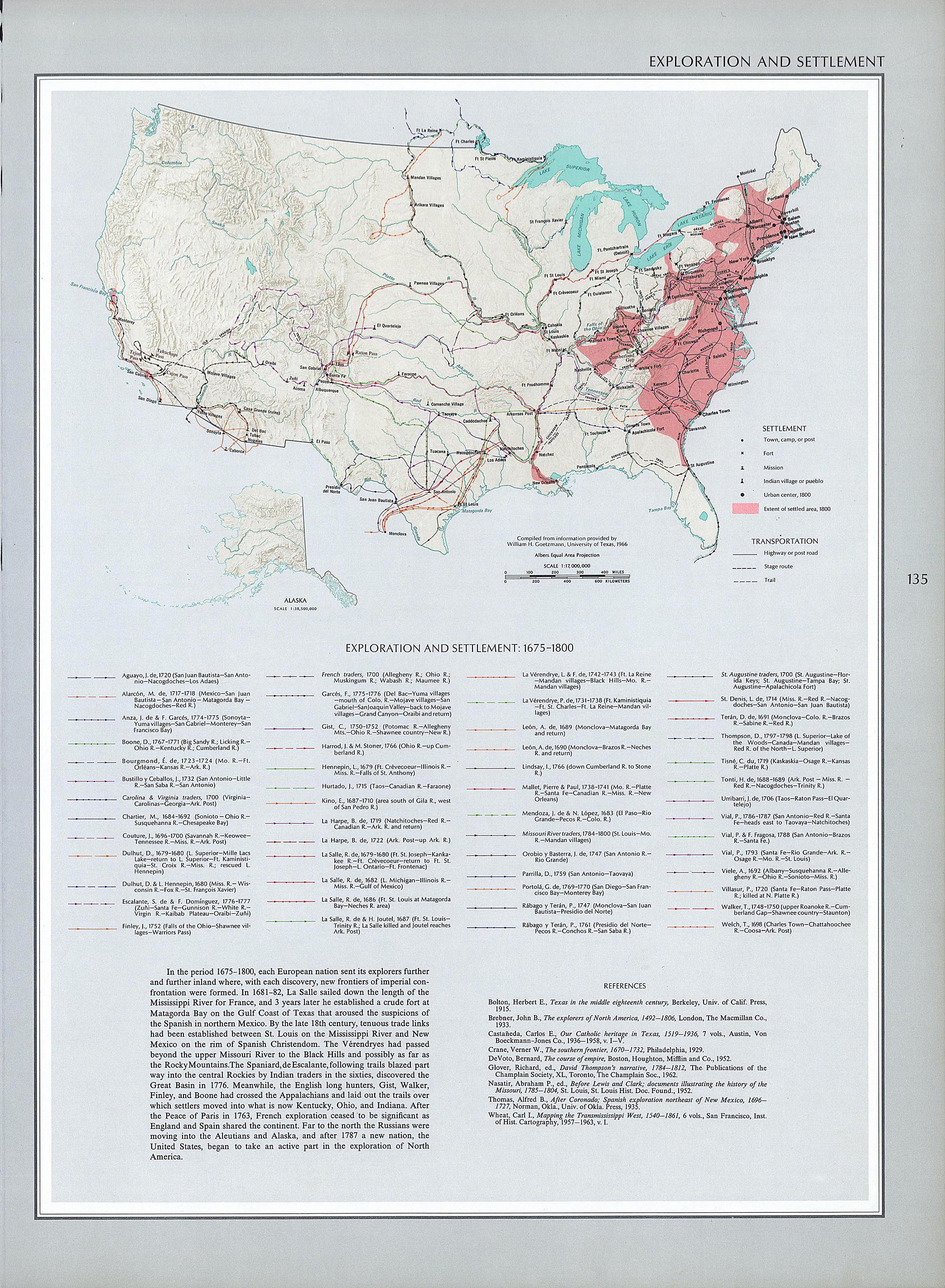 |
| Exploration and Settlement 1675 - 1800 |
His writings describe meeting the Sapony tribe on the Staunton (Roanoke) River, and then continuing on upriver to its headwaters near Salem and then to New River near Pearisburg, Virginia.
• Col. William Byrd's Observations 1728-33, is an account by William Byrd II of the surveying of the border between North Carolina and Virginia in 1728. It contains invaluable notes on the botany and zoology of the area and on the customs, superstitions, and ways of life of the Indians.
In the History of the Indians of Halifax County, Virginia, written by Tom Stevens of South Boston, Virginia, Tom takes us from The Paleoindian Period (ca. 13,000 B.C.to 7,900 B.C.) up through to the Historic Period - the time that the first European explorers discovered who lived on this continent.
Rediscovering Pittsylvania's "Missing" Native Americans By Henry H. Mitchell
Virginia Indians by an unknown student at UVa
Virginia Council on Indians
The Halifax County Tribes:
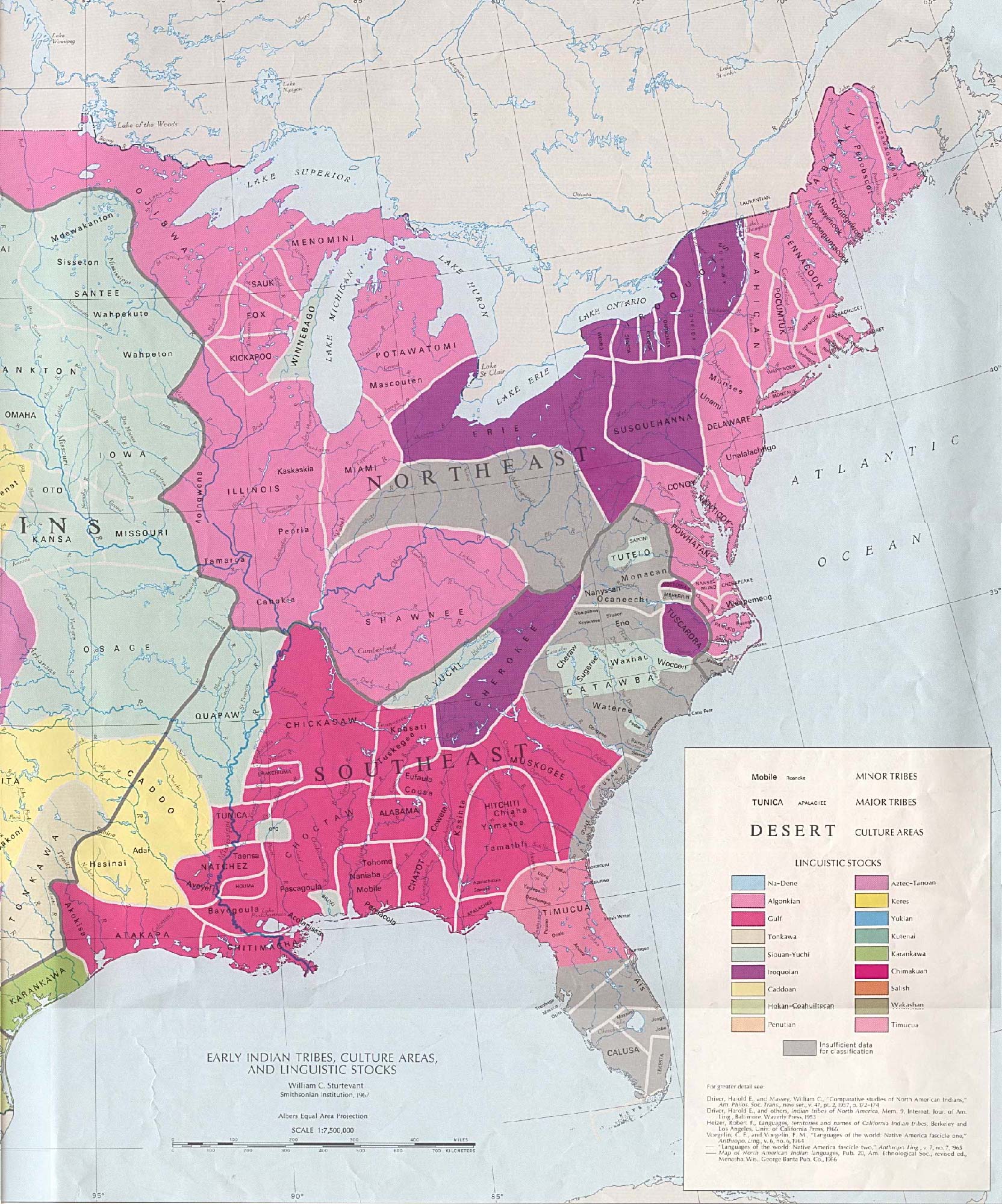 Tribes in and around present day Halifax County were consistantly harassed by Iroquois tribes, whose imperialist, expansionist conquests were focused on monopolizing the fur trade with the colonists. These were the Mohawk, Oneida, Onondaga, Cayuga, Seneca, and Tuscarora. Two other tribes in Virginia were the the Nottoway and Meherrin. Around 1670, the Iroquois drove the Siouan Mannahoac tribe out of the northern Virginia Piedmont region.
Our local tribes moved many times during this same period to avoid the Iroquis land grabs and slaughter. (See Saponi sightings map.)
In 1714, Lt. Governor of Virginia Alexander Spotswood created Fort Christanna in present day Brunswick County to provide protection for white settlers and friendly Siouan-speaking tribes. Although the formal arrangements with the government ended in 1717 the Saponi and Tutelo remained on the tract for several more years. They began moving elsewhere in small bands around 1730.
Occaneechi: A small tribe of the eastern Siouan group formerly residing in south Virginia and northern North Carolina. Their history is closely interwoven with that of the Saponi and Tutelo, and there is historical evidence that their language was similar.
The first known notice of the Occaneechi is that of Lederer, who visited them in 1670. They then dwelt on the middle and largest island in Roanoke river, just below the confluence of the Staunton and the Dan, near the site of Clarksville, Mecklenburg county, Va. Their fields were on the north bank of the river, where they raised large crops of corn, having always on hand as a reserve a year's supply. Between the date of this visit and 1676 they were joined by the Saponi and Tutelo, who settled on two neighboring islands.
In 1676 the Conestoga sought shelter with them from the attacks of the Iroquois and English. They were hospitably received, but soon attempted to dispossess their benefactors, and, after a battle, were driven out. Being harassed by the Virginians and Iroquois, they left their island and fled south into Carolina.

In 1701 Lawson found them in a village on Eno river, about the present Hillsboro, Orange county, N. C. They combined later with the Saponi, Tutelo, and others. They were cultivators of the soil and traders.
We are assured by Beverley that their dialect was the common language of trade and also of religion over a considerable region. They divided the year into the five seasons of budding or blossoming, ripening, mid-summer, harvest, and winter. They were governed by two chiefs, one presiding in war, the other having charge of their hunting and agriculture. Ceremonial feasting was an important feature of their social life. Their tribal totem was a serpent.
Consult Mooney, Siouan Tribes of the East, Bull. B. A. E., 1894.
Occaneechi Band of the Saponi Nation
Occaneechi (also Occoneechee and Akenatzy)

"The anthropologist John R. Swanton agrees with James Mooney, Hale, Bushnell and other scholars that the Saponi were probably the same as the Monasuccapanough, a people mentioned as tributary to the Monacans by John Smith in 1608. Their main village as described then is believed to have been in the vicinity of present-day Charlottesville, Virginia." (Source)
Saponi: One of the eastern Siouan tribes, living in North Carolina and Virginia. The tribal name was occasionally applied to the whole group of Ft Christanna tribes, also occasionally included under Tutelo. That this tribe belonged to the Siouan stock has been placed beyond doubt by the investigations of Hale and Mooney. Their language appears to have been the same as the Tutelo to the extent that the people of the two tribes could readily understand each other. Mooney has shown that the few Saponi words recorded are Siouan.
Lederer mentions a war in which the Saponi seem to have been engaged with the Virginia settlers as early as 1654-56, the time of the attack by the Cherokee, probably in alliance with them. The first positive notice is by Lederer (1670), who informs us that he stopped a few days at Sapon, a town of the Tutelo confederacy, situated on a tributary of the upper Roanoke. This village was apparently on Otter river, southwest of Lynchburg, Va. Pintahae is mentioned also as another of their villages near by. It is evident that the Saponi and Tutelo were living at that time in close and apparently confederated relation. In 1671 they were visited by Thomas Batts and others accompanied by two Indian guides. After traveling nearly due west from the mouth of the Appomattox about 140 miles, they came to Sapong, or Saponys, town. Having been harassed by the Iroquois in this locality, the Saponi and Tutelo at a later date removed to the junction of Staunton and Dan rivers, where they settled near the Occaneechi, each tribe occupying an island in the Roanoke in what is now Mecklenburg county, Va. Lawson, who visited these Indians in 1701, found them dwelling on Yadkin river, N. C., near the present site of Salisbury, having removed to the south to escape the attacks of their enemies. Byrd (1729) remarks: "They dwelt formerly not far below the mountains, upon Yadkin river, about 200 miles west and by south from the falls of Roanoak. But about 25 years ago they took refuge in Virginia, being no longer in condition to make head not only against the northern Indians, who are their implacable enemies, but also against most of those to the south. All the nations round about, bearing in mind the havock these Indians used formerly to make among their ancestors in the insolence of their power, did at length avenge it home upon them, and made them glad to apply to this Government for protection."
 Soon after Lawson's visit in 1701 the Saponi and Tutelo left their villages on the Yadkin and moved in toward the settlements, being joined on the way by the Occaneechi and their allied tribes. Together they crossed the Roanoke, evidently before the Tuscarora war of 1711, and made a new settlement, called Sapona Town, a short distance east of that river and 15 miles west of the present Windsor, Bertie county, N. C. Soon after this they and other allied tribes were located by Gov. Spotswood near Ft Christanna, 10 miles north of Roanoke river, about the present Gholsonville, Brunswick county, Va. The name of Sappony creek, in Dinwiddie county, dating hack at least to 1733, indicates that they sometimes extended their excursions north of Nottoway river. Their abode here was not one of quiet, as they were at war with neighboring tribes or their old enemies, the Iroquois. By the treaty at Albany (1722) peace was declared between the northern Indians and the Virginia and Carolina tribes, the Blue Ridge and the Potomac being the boundary line.
 Probably about 1740 the Saponi and Tutelo went north, stopping for a time at Shamokin, in Pennsylvania, about the site of Sunbury, where they and other Indians were visited by the missionary David Brainard in 1745. In 1753 the Cayuga formally adopted the Saponi and Tutelo, who thus became a part of the Six Nations, though all had not then removed to New York. In 1765 the Saponi are mentioned as having 30 warriors living at Tioga, about Sayre, Pa., and other villages on the northern branches of the Susquehanna. A part remained here until 1778, but in 1771 the principal portion had their village in the territory of the Cayuga, about 2 miles south of what is now Ithaca, N. Y. When the Tutelo fled to Canada, soon after 1770, they parted with the Saponi (Hale was informed by the last of the Tutelo) at Niagara, but what became of them afterward is not known. It appears, however, from a treaty made with the Cayuga at Albany in 1780 that a remnant was still living with this tribe on Seneca river in Seneca county, N. Y., after which they disappear from history.
Consult Mooney, Siouan Tribes of the East, Bull. B. A. E., 1894; Bushnell in Am. Anthr., ix, 45-46, 1907.
 Taken from The Trading Path and North Carolina by Rebecca Taft Fecher:
The Occaneechi Saponi tell of their success in regulating the early paths as merchants. In their history, it was a “mart for all Indian trade 500 miles around.” This made the Occaneechi, who controlled crossings first in Virginia, and later near Hillsborough, NC, “very wealthy people being the merchant traders for all this part of the east.” The Occaneechi held a prominent point along the main path from Virginia before being pushed out by colonists. They settled “Occaneechi Island” in the James River (Ed.note: actually the Roanoke) where an important ford led into North Carolina, and regions beyond. This island has now been inundated, and is no longer visible as an important piece of early American history.
Taken from Wm. Byrd's History of the Dividing Line Betwixt Virginia and North Carolina (page 85)
"About three miles from our camp we passed Great creek, and then, after traversing very barren grounds for five miles together, we crossed the Trading Path, and soon after had the pleasure of reaching the uppermost inhabitant. This was a plantation belonging to colonel Mumford, where our men almost burst themselves with potatoes and milk. Yet as great a curiosity as a house was to us foresters, still we chose to lie in the tent, as being much the cleanlier and sweeter lodging.
The Trading Path above-mentioned receives its name from being the route the traders take with their caravans, when they go to traffic with the Catawbas and other southern Indians. The Catawbas live about two hundred and fifty miles beyond Roanoke river, and yet our traders find their account in transporting goods from Virginia to trade with them at their own town. The common method of carrying on this Indian commerce is as follows: Gentlemen send for goods proper for such a trade from England, and then either venture them out at their own risk to the Indian towns, or else credit some traders with them of substance and reputation, to be paid in skins at a certain price agreed betwixt them. The goods for the Indian trade consist chiefly in guns, powder, shot, hatchets, (which the Indians call tomahawks,) kettles, red and blue planes, Duffields, Stroudwater blankets, and some cutlery wares, brass rings and other trinkets. These wares are made up into packs and carried upon horses, each load being from one hundred and fifty to two hundred pounds, with which they are able to travel about twenty miles a day, if forage happen to be plentiful. Formerly a hundred horses have been employed in one of these Indian caravans, under the conduct of fifteen or sixteen persons only, but now the trade is much impaired, insomuch that they seldom go with half that number. The course from Roanoke to the Catawbas is laid down nearest south-west, and lies through a fine country, that is watered by several beautiful rivers"
More information:
• William Byrd Meets the Sapponies
• The Saponi Nation of Ohio
• For centuries the Sappony have called home the area known as the High Plains Indian Settlement located among the rolling hills found between the waters of the Hyco River, Mayo Creek, and Blew Wing Creek.
• Indian Jim's Cave
• The Occaneechi Band of the Saponi Nation
• Bacon's Rebellion and the Defeat of the Saponi Tribes at Occoneechee Island
• Haliwa-Saponi (Wikipedia)
• Haliwa-Saponi Official Web Site
• Searching For Saponi Town
• Saponi, from The Indian Tribes of North America, by John R. Swanton
 Tutelo: One of the eastern Siouan tribes, formerly living in Virginia and North Carolina. The relation of the Tutelo appears to have been most intimate with the Saponi, the language of the two tribes being substantially the same. Their intimate association with the Occaneechi and their allied tribes indicates ethnic relationship. The history of the Tutelo is virtually the same as that of the Saponi. The name Tutelo, although by the English commonly used to designate a particular tribe, was by the Iroquois applied as a generic term for all the Siouan tribes of Virginia and Carolina, being applied more particularly to the allied tribes gathered at Ft Christanna (see Christanna Indians).
 They are first mentioned by Capt. John Smith in 1609 under the names of Monacan and Mannahoac, with many subtribes, occupying the upper waters of James and Rappahannock rivers, Va., and described by him as very barbarous, subsisting chiefly on the products of the chase and wild fruits. They were at constant war with the Powhatan Indians and in mortal dread of the Iroquois. Lederer, in his exploration from Virginia into North Carolina in 1670, passed through their territory and mentions the names of Nahyssan (Monahassanough) and Sapon (Saponi). In their frontier position at the base of the mountains the Saponi and Tutelo were directly in the path of the Iroquois.
Unable to with stand the constant attacks of these northern enemies, they abandoned this location some time between 1671 and 1701, and removed to the junction of Staunton and Dan rivers, where they established themselves near their friends and kinsmen, the Occaneechi, occupying two of the islands in the Roanoke immediately below the forks, the Tutelo settling on the upper one. How long they remained here is unknown; it is certain, however, that in 1701 Lawson found the Saponi on Yadkin river, N. C., and says that the Tutelo were living in the neighboring mountains toward the west, probably about the headwaters of the Yadkin. At this time, according to Lawson, the 5 Siouan tribes, the Tutelo, Saponi, Keyauwee, Occaneechi, and Shakori, numbered together only about 750 souls. Soon after Lawson's visit they all moved in toward the white settlements, and, crossing the Roanoke, occupied a village called Sapona town, a short distance east of the river, about 15 miles west of the present Windsor, Bertie county, N. C. Soon after this they removed and settled near Ft. Christanna (see Christanna Indians, Totero).
In 1722, through the efforts of the Colonial governments, peace was finally made between the Iroquois and the Virginia tribes. In consequence the Saponi and Tutelo some years later moved to the north and settled on the Susquehanna at Shamokin, Pa., under Iroquois protection, later moving up the river to Skogari. Their chiefs were allowed to sit in the great council of the Six Nations. In 1763 the two tribes, together with the Nanticoke and Conoy, numbered, according to Sir Wm. Johnson, 200 men, possibly 1,000 souls. In 1771 the Tutelo were settled on the east side of Cayuga inlet, about 3 miles from the south end of the lake, in a town called Coreorgonel, which was destroyed in 1779 by Gen. Sullivan.
Consult Hale in Proc. Am. Philos. Soc., xxi, no. 114,1883; Mooney, Siouan Tribes of the East, 1894.