
| October 29, 2004 |
|
Antiquities
Group May Acquire Mill 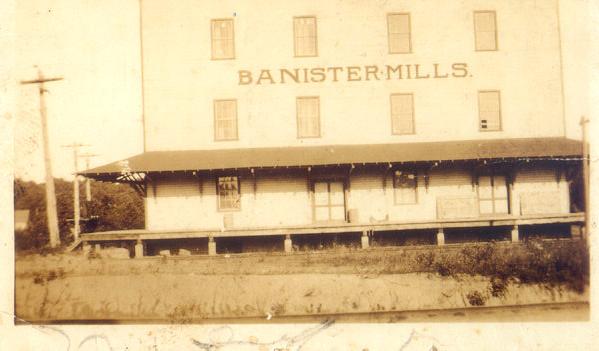 An array of options were presented to the citizens including turning the mill into a bed and breakfast, art studios or office space, depending on the needs and desires of the community. 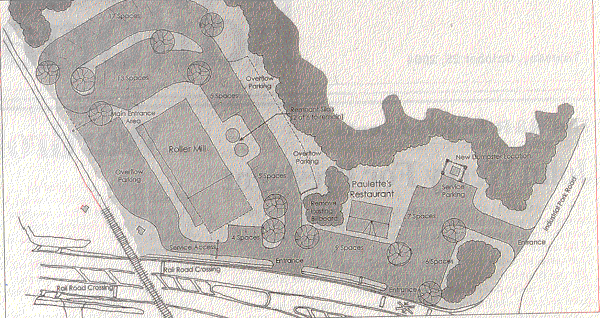 “Think outside the box,” Hill Studio architect
Don Harwood told the crowd. “Because the opportunities
are limitless.
“Think outside the box,” Hill Studio architect
Don Harwood told the crowd. “Because the opportunities
are limitless.“It could be a community space that hosts everything from Friday night movies to wedding receptions,” he added. In a Power Point presentation Architectural Historian Alison Blanton showed the audience examples of other mills around the country that have undergone transformations to fit the specific needs of a community. Mills were transformed into community centers, offices, restaurants or apartments. Sometimes a combination worked, one mill was transformed to office space on the first floor and high-end downtown apartments on the second. “This space could be very versatile,” Blanton said. “That’s why we want to work with you to see what will work in Halifax.” The roller mill sits at the southern gateway to the town, making it one of the first buildings people see entering Halifax from the south. 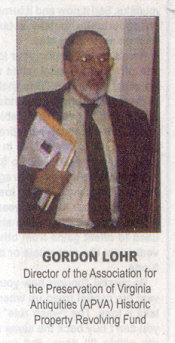 “This mill being in the gateway to town has some great
potential,” said Gordon Lohr, director of the Association
for the Preservation of Virginia Antiquities (APVA) Historic
Property Revolving Fund. “There are several floors
of good, quality square footage that should be marketable.”
“This mill being in the gateway to town has some great
potential,” said Gordon Lohr, director of the Association
for the Preservation of Virginia Antiquities (APVA) Historic
Property Revolving Fund. “There are several floors
of good, quality square footage that should be marketable.”
Lohr and the APVA have expressed interest in taking interim ownership until a permanent owner who wants to develop the property can be found. Negotiations are currently underway with the mill’s owners and the owners of adjacent properties, Lohr said. The first step for the mill is much-needed stabilization to address roof problems and some structural concerns. “This building has to addressed in the very near future to prevent any further deterioration,” Harwood said. There are funding options and incentives available to help with the restoration of the structure. Historic Tax Credits and New Market Tax Credits are among options that Halifax could pursue to help pay for the stabilization of the building. After the mill presentation, the Town of Halifax Planning Commission met Evie Slone, director of planning, with Hill Studio about updates to the town’s sign ordinance and design guidelines. Slone made recommendations to the commission about restricting the size of signs, illumination of signs, especially in residential areas, and the time frame for removing temporary signs. Existing signs would be grandfathered in under the new ordinances. Cheryl Watts, proprietor of Halifax Floral and Framing Studio, expressed concern to the commission that the new ordinances may be too restrictive regarding size toward businesses that are outside of downtown or recessed off the road. The commissioners agreed to hear more from her individually and take her concerns under advisement. The commission reviewed the comprehensive plan revision techniques and implementation material from the Rural Planning Caucus of Virginia and worked towards an updated strategic plan for the town. Planners also recommended the Scenic Byways Nomination for State 360 and Route 57 to Council. Naming these roads to Virginia’s Scenic Byways program will give the roads special designations and signs from VDOT. |